François Leclerc
François Leclerc is a world-renowned French climatologist from Paris, recruited by Eva Stratt to lead the tracking, understanding, and—if possible—amelioration of the climate effects caused by Astrophage. He is the reluctant architect of the nuclear strike on Antarctica, a desperate measure to release methane and buy humanity a few extra years before the sun's dimming triggers mass starvation. Leclerc embodies the moral anguish of a lifelong environmental activist forced to commit an act of planetary-scale destruction in order to save his species.
Background and Recruitment
Leclerc is introduced as a climatologist whose climate-prediction models have been proven true repeatedly over the previous twenty years, making him the only expert Stratt could find with that track record. Stratt brings him into the Project Hail Mary leadership, telling the assembled science team that she has put him in charge of tracking, understanding, and—if possible—ameliorating the climate effects of Astrophage. Leclerc's response to the scope of the task is a halfhearted wave and a quickly fading smile, signaling his deep unease from the outset.
The Nineteen-Year Prediction
When Stratt demands tangible numbers rather than vague predictions, Leclerc delivers a devastating estimate: nineteen years from the time of the meeting, half the people then alive—3.5 billion humans—will be dead. He explains that the math of famine is straightforward: take all the calories the world produces per day and divide by about 1,500; the human population cannot exceed that number for long. Global staple crops—wheat, barley, millet, potatoes, soy, and most critically rice—are all sensitive to temperature ranges. A frozen rice paddy, a flooded potato farm, or a wheat field hit with ten times normal humidity and fungal parasites will all fail. The silence that follows his pronouncement is unlike anything the room has ever experienced; even Stratt is taken aback. When she protests that the Hail Mary needs at least twenty-six years—thirteen to reach Tau Ceti and thirteen for data to return—Leclerc looks at her as if she has grown another head, insisting that this is not an optional outcome but a certainty.
The Antarctica Decision
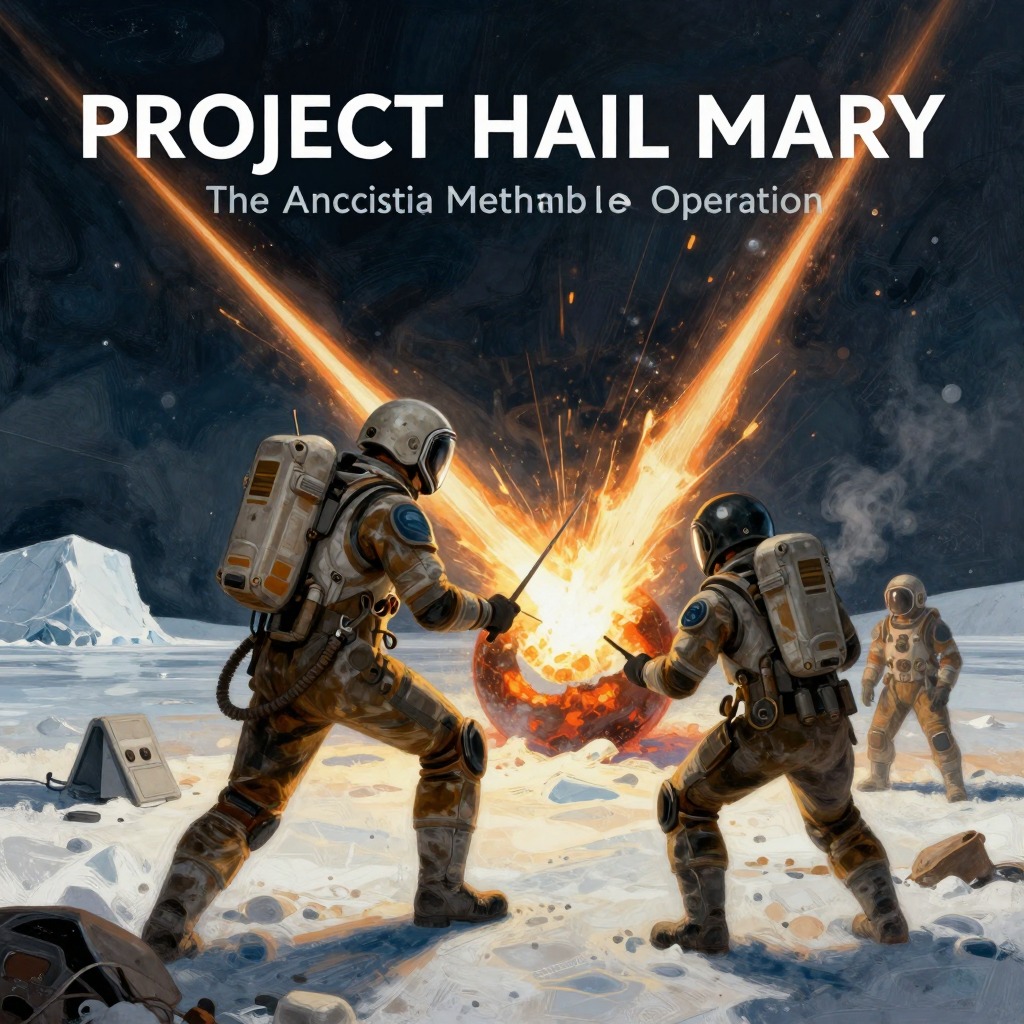
Leclerc is the man who orders the nuclear strike on Antarctica. He describes himself as a lifelong unapologetic hippie—a tree-hugging antiwar throwback from his childhood in Lyon through his university days in Paris—who became a climatologist to help save the world from the nightmarish environmental catastrophe humanity was already sinking into. Now he is ordering 241 nuclear weapons, buried fifty meters deep along a fissure at three-kilometer intervals, all detonated simultaneously. The explosions will cleave the ice shelf, sending it into the sea to melt, releasing enormous quantities of methane trapped in the ice. Methane is a far more powerful greenhouse gas than carbon dioxide, and it breaks down in the atmosphere after ten years, meaning the warming effect can be moderated by knocking more chunks of Antarctica into the sea every few years, and if the Hail Mary finds a solution, humanity only has to wait a decade for the methane to dissipate. Leclerc acknowledges that the disruption to the ecosystem will still be massive—horrific and unpredictable weather, crop failures, biome annihilation—but it might keep the worst at bay. When the nukes detonate, he buries his face in his hands and cries. Stratt puts her hand on his shoulder and tells him he did what he had to do; he replies that he tells himself the same thing.
Thematic Significance
Leclerc represents the moral cost of survival. He is a man who spent his entire career trying to prevent environmental catastrophe, only to be forced by an even greater catastrophe to commit an act of environmental vandalism on a scale never before imagined. His personal anguish—the tears on the carrier deck, the self-description as a tree-hugger ordering a nuclear strike—makes him the conscience of the project, the character who feels the weight of every terrible choice that Stratt makes with cold efficiency. He also embodies the narrow window of time humanity has: his nineteen-year prediction is the clock against which the entire Hail Mary mission races, and his methane-release plan is the desperate stopgap that might give the mission the extra years it needs to succeed.